
Sliding front door
One horizontal panel, 17.5 cm tall, running in a top and bottom track. It slides to the left and locks to the right on three recessed magnets, so the opening sits on the right where your working hand naturally goes in.
Cross ventilation, by design
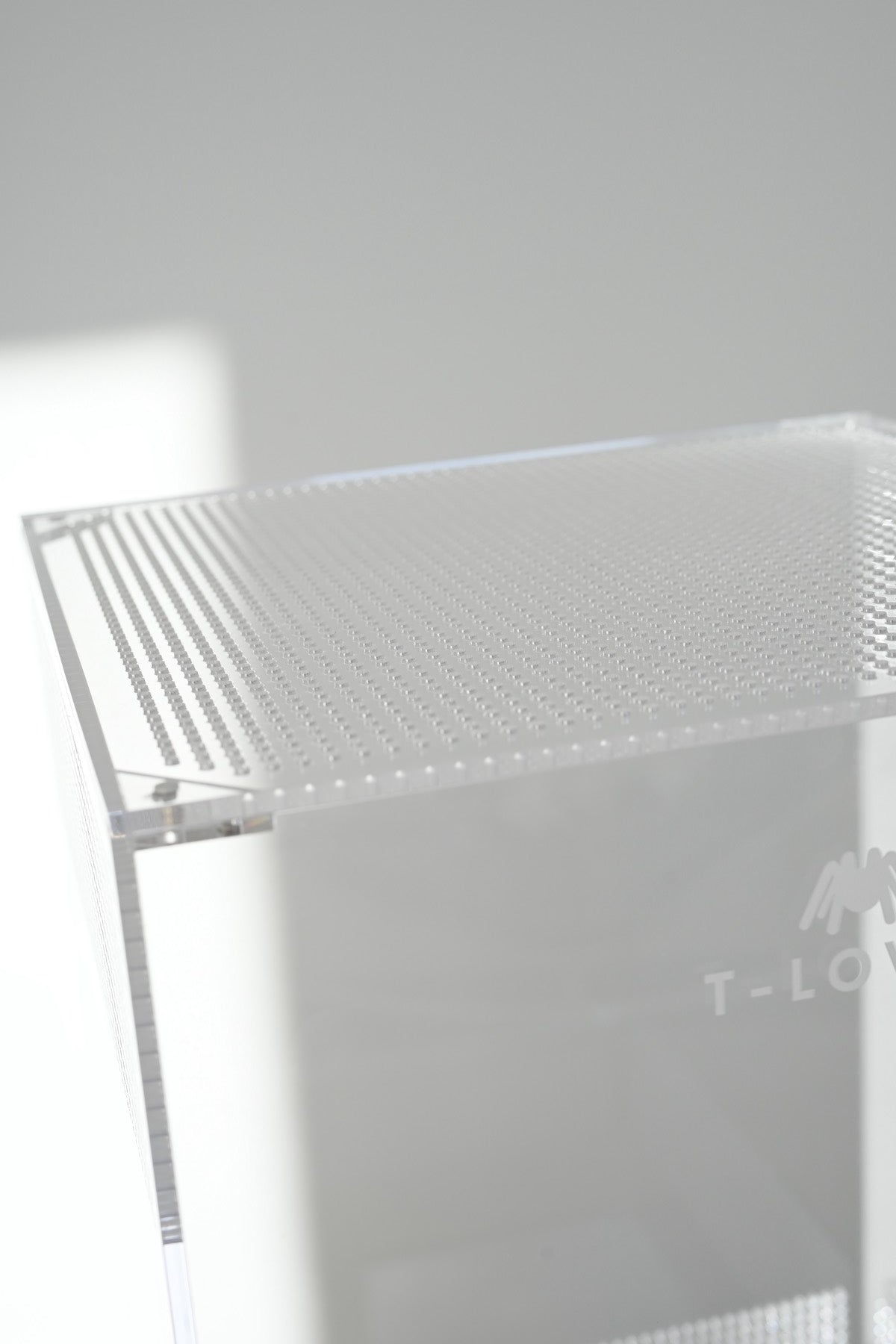
Clear cast acrylic, 30 by 30 by 50 centimetres, with air drawn in low on every face and let out through the side bands and the lid. The air keeps moving instead of standing still.
Airflow
Holes in a lid let air escape. They do not move it. The Arboreal Paradise Adult takes air in through low bands on all four faces, their lower edge six centimetres above the floor, and lets it out through the upper eight centimetres of both side walls and the fully perforated lid. Room air is drawn in low, rises past the damp substrate and leaves at the top, carrying the humid air with it. That constant, quiet exchange is what keeps webbing dry, mould away and your tarantula breathing easily.
Tarantulas breathe through book lungs, and stale, saturated air is hard work for them. A steady exchange is the single best thing you can give an arboreal indoors.
Solvent-welded corners, a base with no holes at all and door and lid seams that close flush on all four edges. Nothing flexes, nothing rattles, nothing has a gap to slip through.
Water the substrate, not the air. With the exchange running you get the damp base and the drier upper zone an arboreal actually wants.
Built around the animal
One horizontal panel, 17.5 cm tall, running in a top and bottom track. It slides to the left and locks to the right on three recessed magnets, so the opening sits on the right where your working hand naturally goes in.
The whole top is one perforated field, 27 by 27 centimetres, and it lifts straight off. Full access when you need it, full exhaust when it is closed.
Every opening in the enclosure is a 3 mm hole. Door and lid seams close gap-free on all four edges. A fast arboreal has nowhere to slip through.
No holes in the floor and none below 6 cm, so five centimetres of substrate sits against solid wall. Damp base, moving air above it.
Bonded, not screwed. No brackets, no visible fixings, no seam for anything to hide in, and square corners that stay square.
Clear cast acrylic, flame-polished edges, magnets sunk flush and the T-LOVER mark etched into the side panel. It looks like furniture, not equipment.
The shop
Thirty by thirty by fifty centimetres of cross-ventilated cast acrylic. One size, built properly.

Materials
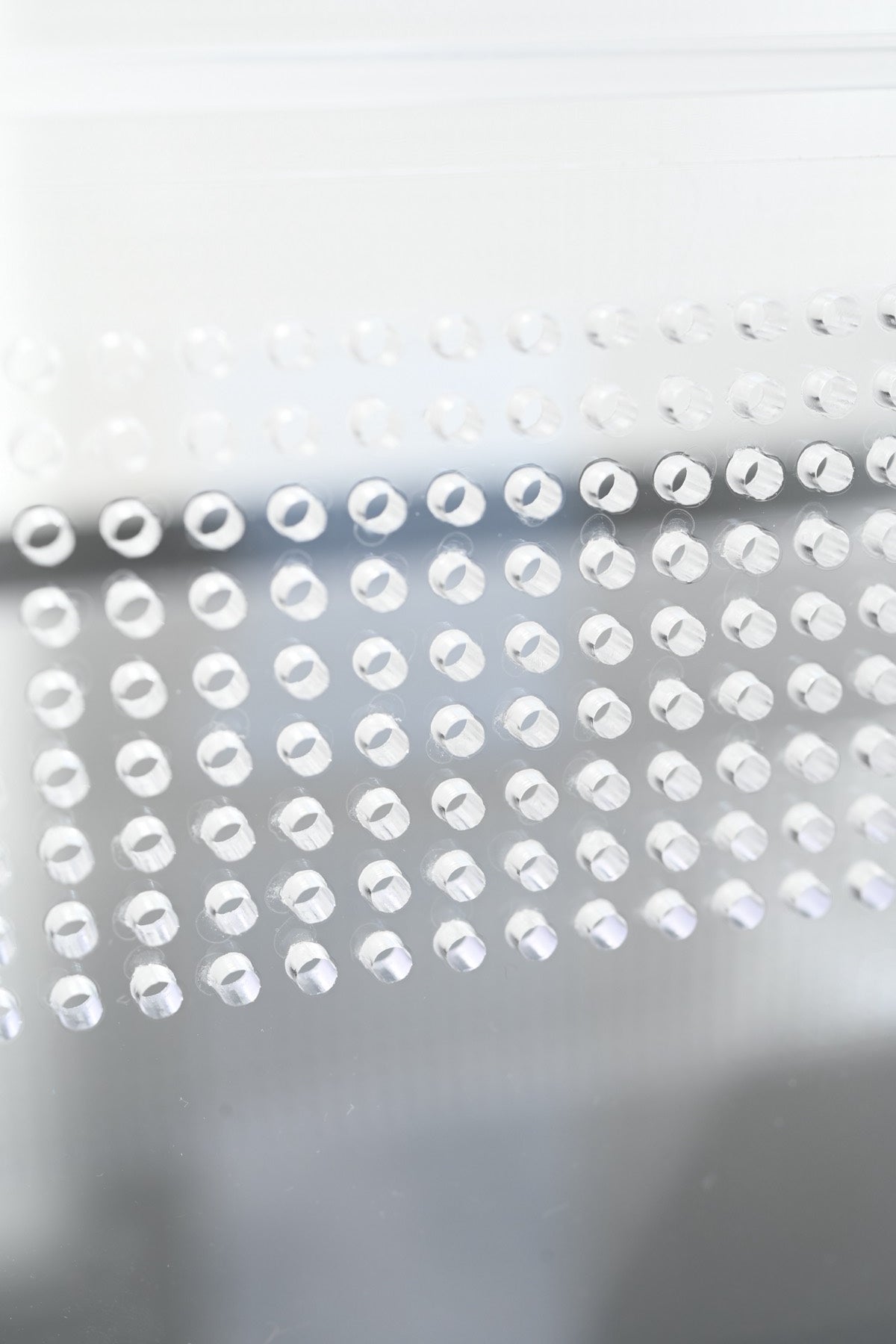
Cast acrylic is clearer than extruded, harder to scratch and it does not fog the way cheap PET does after a year of misting. Every edge is flame polished, every one of the 3 mm holes is deburred, and the corners are solvent welded rather than screwed, so there is nothing sticking out and nothing to work loose.
The etched T-LOVER mark sits on the side panel, deep enough to feel with a fingertip. The result is an enclosure you are happy to have standing in the living room.
Would you want a smaller one?
Right now there is one size, made properly. A smaller enclosure for juveniles and slings is drawn but not in production, because we only want to make it if enough of you actually need it. Put your name down and pick the size you would buy. No payment, no obligation, just a headcount.
Journal

A tarantula can pass through any gap its carapace fits through. Here is how to check an enclosure before you trust it with a fast arboreal.
Read more
Heat mats, lamps and the question keepers ask every autumn. Room temperature is usually the answer, and here is why heating the glass is not.
Read more
The most vulnerable week in a tarantula's year, and the one where keepers do the most damage by trying to help.
Read more